Five Simple But Impactful Style Tips


None of these tips are a replacement for determining the shapes and silhouettes that you feel best in - or for getting clear on what you want your style to be. But all of them can help you to prevent regrettable purchases, construct more interesting outfits, and generally have more fun with your clothes. Here are five tips that I use all of the time with my style coaching clients:

Simple Tip #1: Find a good shopping partner. This can be your best friend, your sister, your romantic partner…or for many of my clients it’s me! This person doesn’t necessarily have to go physically shopping with you, but they need to be able to give helpful feedback when you try things on (via photos or in real life). Honesty is a plus, and so is honesty that doesn’t hurt your feelings so badly that you never want to talk to them again. Ideally, this person knows you well enough that they’ll be able to talk sense into you when you swear you’re going to wear something that you definitely won’t. It’s also a bonus if they can gently push you out of your comfort zone and suggest new or interesting things for you to try.

Simple Tip #2: Shop with a plan. Aimless shopping can be fun and spark creative purchases, but if all of your shopping is of the aimless variety, you're probably going to wind up with a wardrobe full of things that don't go together. Balance fun shopping with “I’m on a mission” shopping. Sometimes you need to focus your efforts on finding a couple of work-appropriate dresses, or a comfy pair of walking shoes. I keep a running list of clothing items I’d like to acquire during the current or upcoming season. This keeps my wishlist top of mind. Don’t forget to ask yourself strategic questions when shopping, like “What am I going to wear this sweater with?” or “Does this dress capture the essence of what I want my style to be?”

Simple Tip #3: Try things on, even when you think they might not work. Obviously, use common sense here. If you know that anything mini-length looks terrible on you, don’t waste your time repeatedly trying on mini dresses. But looking at something on the hanger is really no substitute for trying it on. Sometimes that sleeve you thought looked weird on the mannequin is actually great once you put it on your real body, or that boxy cropped sweater has a nice drape and flow against your waistline compared to how it looked on the hanger.

Simple Tip #4: Don’t fall for the myth of variety. How many times have you bought something because it was different from everything else you had, but you never really wore it? It’s totally okay if most of the items in your wardrobe resemble one another in style - in fact, it probably means that you know what you like, and you know what works for your body. There are plenty of opportunities to introduce variety into your outfits without reinventing the wheel, like choosing new colors in your palette, accessorizing with jewelry or scarves, and playing around with different necklines. There’s room for outlier pieces, but make sure they fit into the larger context of your style, and that you’ll actually be motivated to leave the house wearing them.

Simple Tip #5: Photograph your outfits. Seeing ourselves through the lens of a camera can help us to be more objective about what we and our clothes actually look like. You can photograph yourself in a mirror, set up a tripod, or have someone else take your photo. Pictures can help us see what is and isn’t working about an outfit, from fit and proportion issues to colors that don’t quite make sense together. It’s also really convenient to to be able to look back on your outfits over the years. Bonus: Combine this tip with tip #1, and find a trusted person to give feedback on your outfit photos.
How to Create a Capsule Wardrobe That Isn't Totally Boring


How many times have you read a capsule wardrobe guide suggesting you construct your wardrobe out of only navy, white, and khaki? 

Or for the more adventurous: black, cream, and forest green?

How many times have you read a capsule wardrobe guide suggesting you run out and buy a khaki trench coat that is surely going to become a wardrobe staple?

Honestly these guides bore me to absolute tears, and have since long before I’d ever even heard of color and style analysis. 

The problem with these guides is that they are boring. They are SO boring. And in being so boring, they squash any semblance of the creativity, individuality, and excitement that can be present in getting dressed every morning. You might not have to think about your wardrobe at all, but are you even going to like it?

You can work with a limited color palette, a limited silhouette, and/or a limited number of items and be very, very happy with your wardrobe. I’ve done so for many years.

But the secret is to get clear on what YOU - you personally, not the person being paid to write an article with sponsored links - look good in, are comfortable wearing, and feel excited by.

If that happens to be a palette of black, cream, and forest green with a khaki trench coat thrown into the mix, then more power to you.

If not (or if you just don’t know how to turn those things into a functional capsule), I have some tips for you:

  1. Yes, you should pick your neutrals. In a limited wardrobe, juggling too many neutrals can get complicated and annoying, unless you’re really into mixed neutrals/metals (which is totally valid). For most people, this comes down to making choices between white or cream, black or brown, and silver or gold. Don’t forget about metallics. They can be really impactful as elevated neutrals, especially in shoes and bags.

  2. Choose your favorite flattering colors. When you wear the colors you look good in, your outfits get an immediate boost with little effort. You may want a rainbow of color in your capsule wardrobe (which is where working with a specific season can give you a lot of flexibility), or you may want to limit your palette to a few specific tones. Maybe you want to work with a few neutrals and a color, or a few colors and a neutral. Think about how your chosen colors will work together in terms of specific pieces. Will you wear neutrals on the top or on the bottom? Will you use colors in your accessories? Pinterest (or even the color combo strip on your TCI swatchbook if you have one) can be great resources for this. Don’t just look at clothing, either: think about color palettes you’ve seen in the wild that appeal to you.

  3. Choose your silhouette(s). Most people favor a couple of silhouettes in clothing, and it makes sense to limit your capsule to those silhouettes for the greatest permutations of mixing and matching. If you don’t already know your best proportions and silhouette strategy, this where a Personal Image Analysis can come in handy.

  4. Think seasonally. Your ideal color palette and silhouette strategy may change according to the weather. In the summer, I live in fit-and-flare dresses or bodycon midi dresses. In the winter, I love cozy sweaters with jeans or nice leggings. Think about the colors and styles you gravitate toward season-by-season, and consider having a spring/summer capsule and a fall/winter capsule for maximum flexibility.

  5. Examine your lifestyle. Do you work in an office? Do you work from home? How often do you go out socially? Do you spend lots of time in your yard? Are you riding public transit? Are you engaging in public speaking? Do you have little kids who are frequently wiping peanut butter on you? Practical considerations will heavily influence the clothing you need and the clothing you will actually wear.

  6. Be honest with yourself. Do you have anywhere to wear a trench coat? Do you even like trench coats? If the answer to both is yes, then buy a fabulous one. If the answer to either question is no, they are not an essential item in your capsule wardrobe and you should skip them. Likewise, make sure you’re not purchasing for your fantasy self who has her own show on Netflix. A little romanticizing of our wardrobes is wonderful, but you should be purchasing for your real life, not your fantasy one.

  7. Balance repetition and visual interest. A wardrobe full of solid colors and plain textures can feel uninspired, but you might be worried that if you jazz up your capsule pieces, people will notice how often you repeat your clothing. I personally don’t care if people see me in the same colorful patterns all the time, but I know that some people want to keep their capsule wardrobes interesting while still flying under-the-radar. If that’s you, look for textures like rib or cable knits, crepe, or shirring/smocking. Neckline details like cutouts, embroidery, lace, buttons, or contrasting trim can be subtle but impactful. And don’t forget the sleeves: bishop sleeves, dolman sleeves, split sleeves, or cuffed sleeves can make a plain blouse feel more intriguing. Accessories, particularly colorful ones, can be very effective for spicing up simple outfits.

  8. Be flexible. There are no hard and fast rules. You can do whatever you want! How well your capsule works for you, and how happy it makes you, is much more important than the specific number of pieces you have in your capsule. Maybe you choose to limit your clothing pieces but not your accessories, or you have an actual uniform that you wear every day. The only person your wardrobe needs to work for is you, so take the inspiration that speaks to you, and leave the rest behind.

What's the Difference: Bright Winter vs Bright Spring


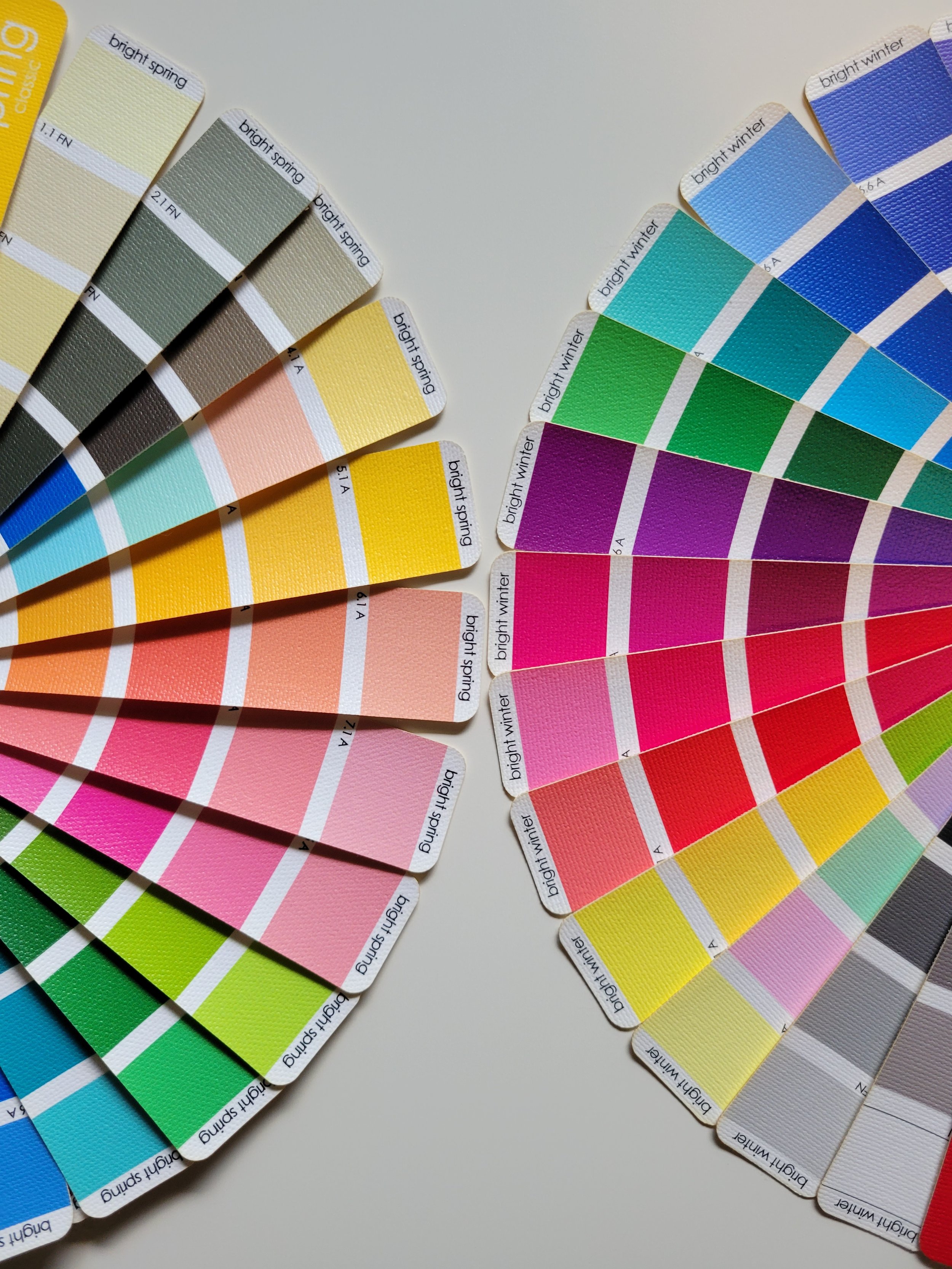
Bright Spring Classic and Bright Winter Classic Swatchbooks by True Colour International


I get so many questions about these two seasons that I’m surprised they weren’t the most-requested comparison right out of the gate!

First, let’s explore their technical parameters:

Bright Winter and Bright Spring are both situated between True Winter and True Spring on the seasonal color clock, meaning that they’re both blends of True Winter (cool, saturated, high contrast) and True Spring (warm, saturated, medium contrast). 

Bright Winter is based in True Winter, with a dash of True Spring’s juicy warmth. Bright Winter is a Cool-Neutral season. Colors are bright and electric. 

Bright Spring is based in True Spring, with a dash of True Winter’s icy intensity. Bright Spring is a Warm-Neutral season. Colors are fresh and tropical. 

Brightness is the most important characteristic of these two seasons. Soft, muted colors will disappear or look dusty on both of the Brights, particularly in makeup. At the same time, rich, dark colors can feel heavy. 

Aside from temperature, one main difference between these two seasons is that Bright Winter is darker and more high contrast than Bright Spring. 

What happens when a Bright Winter wears Bright Spring colors?

A Bright Winter wearing Bright Spring clothing or makeup will often find her skin looking more orange or yellow than it really is. The eyes can lose color and sparkle, and the skin can take on a slightly greasy look. Bright Spring makeup will usually look noticeably too orange or coral, with an overall effect that can come off as slightly childish.

What happens when a Bright Spring wears Bright Winter colors?

A Bright Spring wearing Bright Winter clothing or makeup will often find her skin looking more ashen than it really is. Many Bright Springs notice an artificial “mustache” in Bright Winter due to shadowing, particularly in too-dark or too-cool Bright Winter lipstick. The eyes can appear slightly red and watery, and the overall effect can come off as strained or hard.

How do each of the Brights wear their makeup?

Both of the Bright seasons are flattered by shiny, sparkly, or translucent effects. Bright Winter has a little more wiggle room with matte textures, while Bright Spring has a little more wiggle room with dewy textures. 

Bright Winter is flattered by crisp and clean makeup, and many Bright Winters prefer minimal eye makeup, with high-contrast blush and lipstick. Eye makeup shouldn’t be overly dark or smoky, but a retro eyeliner style can be very flattering. Eyeshadows like Colourpop Uh Oh and Colourpop I Heart This are stunning, along with eyeliners like Lancôme Black Coffee and Moira Beauty Sapphire Blue. For cheeks, fuchsia and cool hot pinks like MAC Full Fuchsia and Surratt Classique. For lips, intense fuchsias are a popular choice, like Revlon Fuchsia Fusion or Maybelline Fuchsia For Me, as well as clear cherry reds like Dior Red Smile.

Bright Spring is flattered by fresh and sunny makeup, with many Bright Springs appreciating a dewy look, or even over-the-top shine via highlighter. Too-dark eyeshadows and liners can look heavy on the Bright Spring face, but colorful ones can look surprisingly normal. Peachy eyeshadows like MAC Orb and Stila Kitten are perfect, along with eyeliners like Moira Beauty Soft Gold and Hourglass Meteorite. For cheeks, bright strawberry pinks and corals like Benefit Crystah and Moira I Adore You are gorgeous, and for highlighters, look at Colourpop Lunch Money or Moira Bubbly Champagne. For lips, warm hot pinks and pinky-corals, like Dior Lucky and L’Oreal Raspberry Rush.

Can these two seasons “cheat” with some of the same colors?

Technically speaking, colors belong to one palette or the other, but in real life, they may borrow from each other occasionally. The success of this can depend on the size of the piece (an earring, vs a sweater, vs a shoe), where on the body the color is worn, and the individual in question. These two seasons don’t tend to share a lot of makeup shades, but there are always exceptions. Eyeshadow and eyeliner are somewhat malleable due to differences in blending and application style, and of course, every individual may have a different sweet spot in her season.

If you’d like to explore these two seasons further, check out my Pinterest boards:

Does Your Style Exist Only In Your Imagination?

“[Clothes] are our social shells; projections of our inner selves; indicators of wealth and status. From an early age literature teaches us how to "read" an outfit, beginning with the children's fairy stories where we learn to recognise the wicked witch by her black robes. In a novel, a beautifully described outfit can be used to enhance characterisation, turn a narrative or create a powerful visual snapshot of a scene. A pair of trousers, a dress, a hat may carry any number of political, social and aesthetic meanings.”

-Helen Gordon

Soft Autumn Classic Swatchbook by True Colour International

The outfits you actually wear say leagues more about your style personality than your carefully-crafted Pinterest board or the unworn items hanging in your closet.

It’s not uncommon for a client to come to me and describe herself with words like “mysterious,” “edgy”, and “cool,” yet wear nothing that says any of those things at all. She herself may be mysterious, edgy, and *extremely* cool - but we’d never know it based on her clothing alone. 

If you’re saving outfits to your style board that don’t work for your body type, or that you’d never consider wearing in real life, it might be time to create a separate board for realistic style ideas. You can always reserve the original for style inspiration.

Not caring about what you wear can be a style statement in and of itself, though it’s less powerful for most of us than we might like. Often we’ll come off looking sloppy instead of the hoped-for “I’m too cool for this.” A uniform (whether full-on Steve Jobs, or a little more creative like Caroline Herrera) can be an effective bridge between the two approaches. 

Accessories like jewelry, bags, scarves, and shoes can save the day by adding pizzazz to more basic outfits, especially for uniform dressers. Accessories are often easier to store than larger wardrobe items, more forgiving of weight/shape/trend changes, and available at a variety of price points.

That said, don’t be afraid of statement wardrobe pieces! Basics and accessories are a great start, but what about a moto jacket with bold hardware in your favorite color? A dress with a cool pattern of 4-6 different colors in your palette? A pair of colorful linen shorts with a paper bag waist?

If you find yourself with a huge gap between how you want to be perceived and what your clothes are actually saying about you, I can help! Maybe you want to look mysterious, edgy, and cool, but you have no idea how to make that happen. If that’s you, I offer a free one-hour exploration call where we can draw up a game plan for your unique style situation. You can book yours here!