What's the Difference: Dark Winter vs Dark Autumn

I’m starting this series with the duo that was most-requested on Instagram: Dark Autumn and Dark Winter.

These two seasons are often mistaken for one another when assessing makeup and clothing. During a color analysis, it’s common for these two seasons to be the last ones standing. Why?
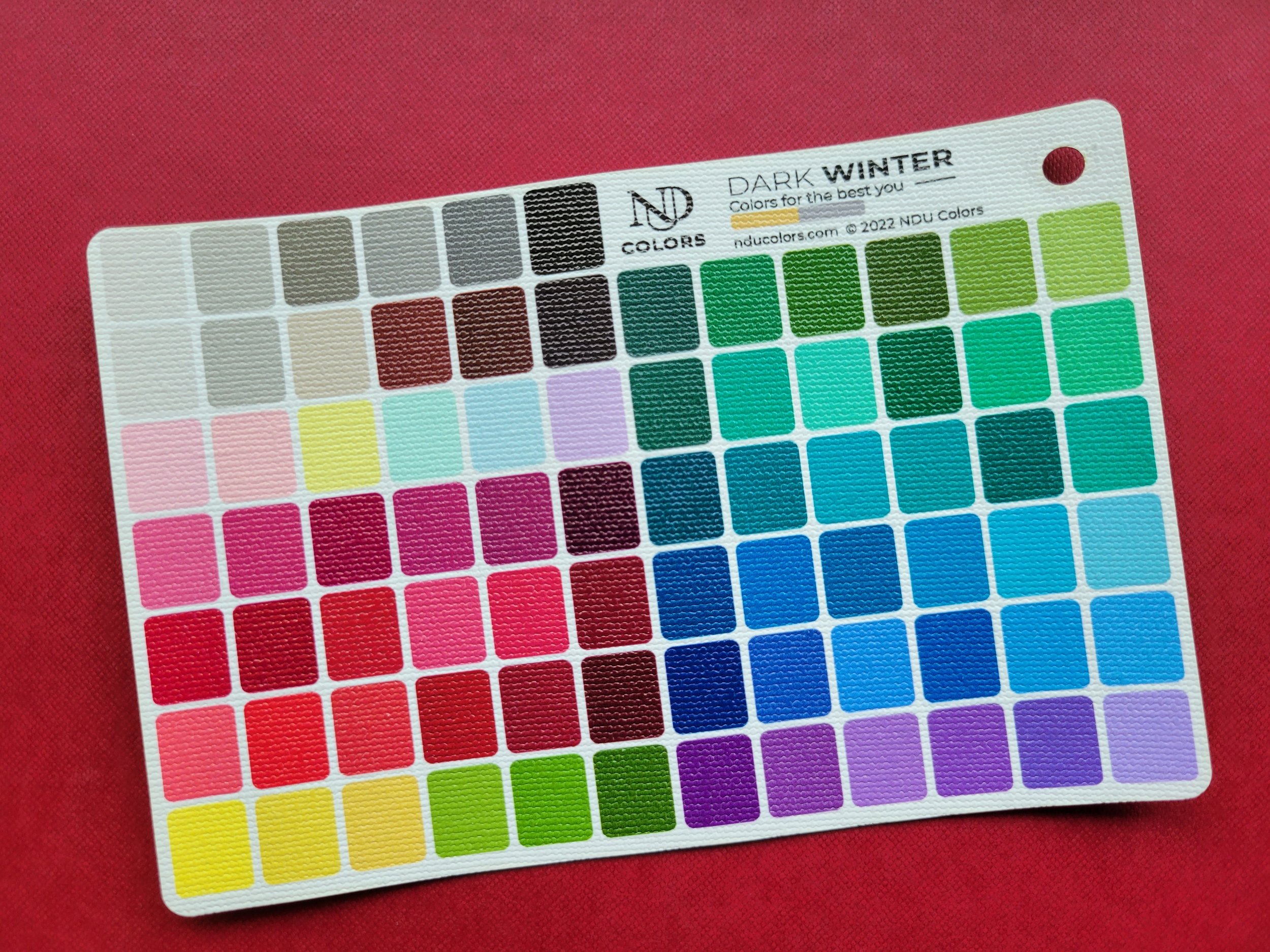


First, let’s explore their technical parameters:

Dark Autumn and Dark Winter are both situated between True Winter and True Autumn on the seasonal color clock, meaning that they are both blends of True Winter (cool, saturated, high contrast) and True Autumn (tawny, muted, medium contrast).

Dark Winter has a base of True Winter, with a dash of True Autumn’s warmth and richness. Dark Winter is a Cool-Neutral season.

Dark Autumn has a base of True Autumn, with a dash of True Winter’s clarity and saturation. Dark Autumn is a Warm-Neutral season.

One major difference between these two seasons is that Dark Winter contains “icy” colors: pure pigment with a drop or two of white added. Icy colors are light like pastels, but far more intense. My rule of thumb is that if you have to ask if a color is icy, it’s not. Dark Autumn doesn’t contain icy colors, and Dark Autumns are generally washed out by very light/bright colors like crisp white.

Darkness is the most important characteristic of these two seasons. That doesn’t mean Dark season people will necessarily look dark themselves, but they are enhanced by deeper colors in makeup and clothing. 

What happens when a Dark Winter wears Dark Autumn colors, and vice versa?

Too-warm colors will turn Dark Winter skin more yellow than it naturally is. Shadows under the eyes or above the lips may be accentuated. Bone structure may soften into a pudding.

Too-cool colors will turn Dark Autumn skin more ashy than it naturally is, sometimes adding blue to the lips or a hazy cast to the eyes. The bone structure may look harsh, even vampiric.

Dark Winters can combine the dark and light extremes of the palette beautifully. Colors are sharp, intense, and slightly jewel-toned. The palette boasts colors such as eggplant, black coffee, and holly leaves and berries.

Dark Autumns will strive for a layered look instead of extreme contrast. Colors are rich, spicy, and organic. The palette boasts colors such as marigold, paprika, and rich olive.

How do these two seasons wear their makeup?

Dark Winter will go for an overall cooler and “cleaner” look, with contrast between eyes, cheeks, and lips. Eyeshadows like MAC Blanc Type and Satin Taupe are at home here, along with eyeliners like Lancôme Black Coffee or MAC Photogravure. For cheeks, smoked berry-rose like Surratt Rougeur or Fenty Cool Berry. And for lips, deep pomegranate shades like Bobbi Brown Red Velvet or MAC Russian Red are stunning.

Dark Autumn will go for an overall more blended look, with more tone-on-tone layering. Autumn eyeshadow palettes abound, and Dark Autumns will be flattered by colors like MAC Charcoal Brown and Woodwinked. For eyeliner, Hourglass Bronze or MAC Teddy. For cheeks, contour and bronzer can be beautiful depending the individual’s skin tone, with copper-red blush like MAC Ambering Rose or NARS Taos. For lips, scorched reds like Estee Lauder Decadent or MAC Dubonnet are gorgeous.

Can these two seasons “cheat” with some of the same colors sometimes?

Technically speaking, colors belong to one palette or the other, and people will be most enhanced and magical in their own season. But in real life, a Dark Autumn may occasionally wear a Dark Winter burgundy, or a Dark Winter may reach for a Dark Autumn navy without feeling the effect too terribly. The success of this can depend on the size of the piece (an earring vs a sweater), where on the body the color is worn, and the individual in question. I haven’t found these two seasons to share many makeup colors successfully.

If you’d like to explore these two seasons further, check out my Pinterest boards:

Where Color and Archetype Meet

My colors didn’t 100% click for me until I started to incorporate my archetype. 

After learning my season, my makeup looked great and my closet was harmonious. But my outfits were still kind of...blah. Certainly more blah than I'd envisioned when looking in excited awe at the luxury drapes during my analysis. I wasn’t fully getting that WOW feeling when I looked in the mirror, because I still didn’t know how to pull the entire picture together. 

After learning my archetype, I saw how the shapes and design details of my outfit could combine with my seasonal palette to tell a story. I was more adventurous with my colors, and I knew which types of patterns actually looked good on me - a huge piece of the puzzle! I never really struggled after that. It was just a matter of asking myself questions about each piece as I bought it:

  1. “Is this my season?”

  2. “Is this right for my archetype?”

  3. “Is this right for my specific body proportions?”

  4. “What am I going to wear it with?”

Guesswork was removed.

For some, marrying color and archetype is an easy and intuitive process, especially if your season and archetype are commonly combined in the collective imagination (think Autumn Naturals and Winter Classics).

For others, it can feel like a battle when common seasonal and archetypal recommendations clash.

True Springs are often told to combine as many colors as they want in their outfits, because True Spring is lively and colorful. That’s true, it is - and this approach will work for many of the archetypes. But at the risk of looking chaotic, a True Spring Dramatic Classic may need to ignore this common True Spring recommendation. She’ll usually have more luck wearing one bold accent color, with neutrals (and maybe a smaller amount of another color) as supporting players. 

Likewise, a Soft Summer Romantic Gamine may struggle with the monochromatic color combinations often favored in Soft Summer forums, finding that her outfits lack spark. She may prefer to create strategic contrast with pairings of the lightest and darkest colors in her palette, or the warmest and coolest. Still, she will need to be careful when harmonizing, to make sure she isn’t unintentionally exceeding the boundaries of the palette.

In personal styling, there is no one size fits all. Each and every Light Spring will have a different stylistic interpretation of her palette, and each and every Dramatic will have a different stylistic interpretation of her archetype. A Light Spring Dramatic will combine her colors and archetype differently from a True Summer Dramatic, or a Light Spring Romantic Classic.

The only way to discover your preferences is to experiment! Use the knowledge you've accumulated on your journey to take steps toward a style that feels fulfilling and exciting to you. And if you want my help, you know where to find me.

Wear The Clothes That Scare You


If you’ve been living in t-shirts and jeans for longer than you can remember, wearing more daring styles can feel scary. Even wearing a nice blouse with an interesting pattern or saturated color for the first time can spark panic.

You might be so accustomed to blending into the background that you’re scared people will react poorly to you in your new clothes, asking you why you’re so dressed up, or “who do you think you are?”

You might be worried that everyone will give you funny looks or talk about you. You know you want to dress more authentically, but you’re not sure how to gain the confidence to actually do it.

I personally experienced this when I started wearing my season’s lipsticks (which were darker than what I had worn before), and to a greater extent, when I started dressing for my archetype. After living in the most basic Target tees with poorly-fitting jeans for years, putting on a half-circle skirt with a colorful blouse, a belt, earrings, and cute shoes felt BOLD. It was scary, and I experienced a heightened self-consciousness while adjusting to my new style.

But just as quickly as the panicked feeling came, it passed.

I began to feel more confident in my new clothes than I ever felt in my old clothes. My new clothes felt like ME, which made me feel safe. Who cares what anyone else thinks about them?

I've learned that other people rarely care about what we’re doing or wearing as much as we fear they do. The people close to you may notice changes in the way you dress and carry yourself, but over time, these changes will become normal.

Feel free to start small! If you’re not confident wearing the clothes that scare you to work, that’s okay. Wear them to the grocery store or coffeeshop instead. After you’ve conquered these low-stakes situations, wear them to your hair appointment. Wear them on a dinner date with your BFF who always hypes you up.

The more you wear the clothes that scare you, the more comfortable they’ll feel. It’s okay to fake it until you make it! The only way out is through.

Are You Shopping For Your Fantasy Life?

When it comes to purchasing clothes you love, an important question to ask yourself is whether you’re shopping for your fantasy self or your real self.


Your fantasy self might be 25 pounds lighter or have a different body shape than you do. Your fantasy self might have a different job, a different lifestyle, or live in a different part of the country.

Some people have closets full of clothes for other selves and other lives (maybe even lives they once lived). Others know that their fantasy wardrobe isn't realistic, so they default to leggings and t-shirts. Both are usually unhappy with their clothes.

An unrealistic wardrobe can be a clue to larger life dissatisfaction, like realizing you’d be happier if you looked for a new job in Arizona already. But more often, I think it’s a misunderstanding. Building a realistic wardrobe doesn’t mean you’re giving up on your dreams for your life in the future.

Building a realistic wardrobe simply means practicing acceptance of where you are in this moment. It means giving yourself permission to shine where you are, and to celebrate your body and your style as it is right now.

In practical terms, ask yourself what really speaks to you about your fantasy wardrobe. How can you adjust aspects of it to better suit your life? If you really wish you could spend your life in ball gowns (to give an extravagant example), then spend some time thinking about how to bring some ball gown sparkle into your workable wardrobe. What about a taffeta blouse? A pussycat bow? Chandelier earrings? A glitzy shoe?

In the grand scheme of life, wearing clothes you love is an easy way to infuse daily life with joy. Your clothes should be working for you, not against you.